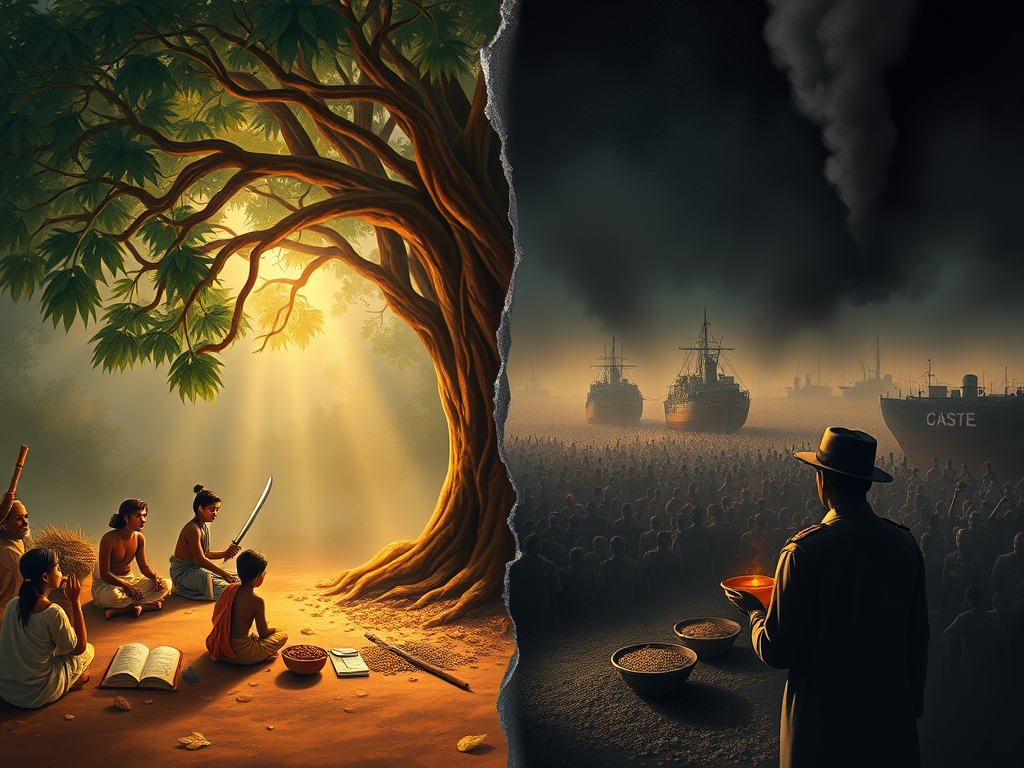
There Was a Problem the British Could Not Solve with Guns
The British East India Company began consolidating power in India in the late 18th century. They quickly discovered something unsettling.
India was not merely a territory.
It was a civilization.
Armies could defeat kingdoms.
Treaties could weaken rulers.
But a civilization rooted in Dharma, Varna, and self-regulating knowledge systems could not be ruled permanently.
The British understood one core truth very early:
As long as Indians understood themselves through Vedic categories, British rule would never be stable.
This realization changed everything.
Studying the Vedas Was a Strategy, Not Curiosity (1760–1820)
Before dismantling Indian systems, the British studied them thoroughly.
In 1784, William Jones established the Asiatic Society of Bengal. His explicit goal was to translate and analyze Sanskrit texts. These included the Vedas, Smritis, Itihasas, and legal traditions.
By the early 1800s, British administrators had reached an uncomfortable conclusion:
- There was no birth-based caste system in the Vedas
- Varna was functional, psychological, and karmic
- Social mobility was built into the system
- Education—not birth—determined one’s role
This meant one thing.
You cannot divide such a society permanently unless you rewrite its self-understanding.
Why Varna Had to Be Destroyed
Varna was not a hierarchy of birth. It was a distribution of responsibility, purely based on guna and karma, reflected by the color of your soul.
This was the first merit based system, based on the highest and purest parameter – the color of the soul!
- Brahmin: cognition, ethics, teaching
- Kshatriya: protection, governance
- Vaishya: production, trade
- Shudra: execution, craftsmanship
Crucially:
- A Brahmin could be born to any family
- A Shudra could rise through education
- Varna could change across lifetimes and even within one life
This fluidity made social freezing impossible.
For colonial control, this was disastrous.
So the British chose a different approach:
Freeze identity. Remove mobility. Convert function into birth.
When the British carried out India’s first caste surveys, they did something deceptively simple—and historically disastrous. Before this, Varna Vyavastha worked like a living system. People were known by what they did. They were also known by how they thought and how they served. Identity could evolve. But the British administration disliked anything fluid; empires run on files, not flexibility.
Beginning with the first all-India Census in 1871–72, colonial officials implemented a system. They asked every Indian to pick one caste. This effort was intensified more aggressively in 1881 and 1901, requiring individuals to lock their caste choice on paper. Officers like H. H. Risley treated society like a museum exhibit—measuring noses, ranking communities, and squeezing complex social realities into neat European categories.
What was once about qualities and actions was reduced to birth certificates and census columns.
This is where Varna froze into caste. A system meant to be dynamic became permanent. A framework designed for self-discovery turned into a lifelong label.
Once written into government records, caste followed you everywhere—school, job, tax records, and social status. Mobility vanished, curiosity died, and identity hardened.
The final trick then arrived. After freezing Indian society this way, the British turned around and said, “Look how backward your ancient caste system is.” A mess created by paperwork was blamed on philosophy.
Varna was never rigid—but once the census stamped it in ink, it stopped breathing.
The Gurukula System: The First Casualty
Before British intervention, India had thousands of Gurukulas where:
- Students from all families were admitted
- Education was free or community-funded, guru dakshuna or fee was optional.
- Teachers assessed aptitude, temperament, discipline, and inclination
- Varna identification was part of educational maturation, not birth labeling
Ancient India had a wonderfully simple way of understanding a child. This understanding instantly exposes the myth of a rigid caste system.
In ancient Gurukulas, understanding a child was almost like watching a story unfold. A young student would sometimes encounter four simple objects. These include a manuscript, or sword or staff, a bag of grains or coins, and tools for service or craft.
No instructions. No pressure. The teachers simply observed. Did the child open the book and ask questions? Pick up the sword with confidence? Weigh the grains thoughtfully? Or instinctively help arrange the tools?
This wasn’t a dramatic one-day test. It happened again and again over the years. As the child grew, the choices often changed—and that was expected. A quiet, studious child might later show leadership. A bold child might develop a reflective mind. Teachers adjusted training accordingly. That’s the key detail most people miss. Change was allowed. In fact, it was watched for.
Now ask the obvious question: if caste were fixed by birth, why do this at all? Why keep testing? Why allow movement? You don’t keep re-checking something that’s already decided. These visual, practical tests existed for a specific reason. Varna was meant to be discovered through nature and action. It was not inherited like a surname.
A rigid caste system would have needed no books, no swords, no observation—just a birth record. The Gurukula did the opposite. It treated children not as labels, but as evolving human beings.
British surveys themselves recorded this.
In the Madras Presidency alone, records from the early 1800s showed one school for every 1,000–1,500 people. This indicated a literacy rate higher than many parts of Europe at the time.
This system had to go if British had to rule this country!!
The Legal Dismantling of Indigenous Education (1813–1854)
The destruction was not accidental. It was legislative.
1813 – Charter Act
- Opened India officially to Christian missionaries
- Began defunding indigenous schools
- Marked the start of religious–educational interference
1835 – Macaulay’s Minute on Education
Authored by Thomas Babington Macaulay
His words were explicit:
“A single shelf of a good European library was worth the whole native literature of India.”
Consequences:
- Sanskrit and Gurukula education defunded
- English declared the medium of “modern” knowledge
- Indigenous scholars pushed into irrelevance
1854 – Wood’s Despatch
- Centralized education under colonial control
- Knowledge shifted from wisdom to employment
- Varna logic was replaced with job training
Education no longer revealed who you are.
It only prepared you to serve the empire.
The Destruction of Ayurveda and Vaidyas
Ayurveda was not just medicine.
It was preventive, ecological, psychological, and spiritual health combined.
British administrators found it dangerous because:
- It was community-based
- It reduced dependency on Western systems
- It reinforced indigenous epistemology
By the mid-1800s:
- Ayurvedic institutions lost patronage
- Western medicine was declared “scientific”
- Vaidyas were delegitimized as untrained quacks
A self-healing society is difficult to rule.
So healing was centralized, monetized, and alienated. India became another testing lab and market for modern medicine.
Census: The Most Dangerous Weapon (1871 Onwards)
If Gurukulas destroyed mobility, the census destroyed memory.
The first all-India census in 1871 forced every Indian to declare a fixed caste identity.
Before Caste Census:
- Identities were contextual
- Occupation could change
- Varna was not recorded at birth
The Upanishads tell us many stories about fluid varna system based on guna and karma, as mentioned in Bhagwad Geeta. One such story is about Satyakaam Jabal, the son of a prostitute. When young Satyakāma Jābāla went to a Gurukula, the teacher asked a simple question: “Who is your father?”
Satyakāma went home, asked his mother, and she honestly said, “I don’t know. I served many men.” No drama. No cover-up.
Satyakāma returned and repeated her words exactly as they were—no polishing, no excuses, no lies. The teacher smiled and said, “Only a true Brahmin speaks like this.” Not because of family, but because his mind refused to bend the truth. That fearless honesty—not birth—revealed his Varna.
But after the Caste Census:
- Caste became permanent
- Birth became destiny
- State records froze fluid identities forever
Institutionalizing Discrimination
Yes—social discrimination existed in pre-British India.
No civilization is perfect. Ancient society definitely had its mess—no civilization runs on divine perfection alone. There was social pollution, ego, and prejudice, and everyone knew it. That’s why reforms, debates, and course-corrections existed. Think of it as a system that knew it needed regular cleaning.
But discrimination was social and reformable, not state-enforced.
The British, however, did something cleverer and far more dangerous: they installed the mess as permanent plumbing. What was once a bad habit became official policy. Flaws got stamped, filed, and preserved forever.
They:
- Turned prejudice into law
- Turned description into destiny
- Turned flexibility into fossilization
Then they blamed Hindus for the results.
Suddenly, social corruption wasn’t a glitch—it was the default setting. And once a society starts calling its mistakes “tradition,” fixing them becomes much harder.
With British Caste Census, what was once a dynamic social ecosystem became a rigid hierarchy.
The Final British Masterstroke: Blame the Victim
After dismantling:
- Gurukulas
- Varna mobility
- Indigenous medicine
- Educational sovereignty
The British did something audacious.
They said:
“This caste system is your ancient Hindu evil.”
And many Indians believed it.
In 1947, we thought that what we achieved freedom. But No! The British didn’t just leave—they moved into our textbooks. For decades, subtle edits, selective chapters, and loud silences kept repeating one idea: caste is ancient, Hindu, and unchangeable.
Any voice that tried to restore Varna Vyavastha, like Arya Samaj, was sidelined, softened, or safely ignored. Independence arrived in 1947, but the mental software stayed colonial. Seventy years passed, flags changed, rulers changed—definitions didn’t.
But Vedic Culture Never Taught External Blame
Here is the most uncomfortable truth.
Vedic culture never blamed the invader.
It taught:
All pollution comes from within, not without.
The British did not create our current condition.
They exploited our loss of awareness.
The biggest problem is that we didn’t try to explore. Instead of checking the source code, we believed it. Chains fell from the body—but the mind stayed occupied.
A civilization that forgets its principles invites collapse.
Therefore, the Real Question Is Not British Guilt
The real question is:
Why are we still living with colonial definitions?
Why do we still identify by frozen caste labels?
Why do we still teach our children British categories of self?
And most, importantly, why are we still following the Caste Census initiated by the British. We should be trying to dissolve it and remove all “castes”.
Political freedom came in 1947.
Psychological freedom has not.
Are You Ready for the Real Freedom Struggle?
The real freedom struggle is internal.
- Freedom from inherited labels
- Freedom from colonial definitions
- Freedom from borrowed identities
The British are gone.
But their categories remain.
Until you recalculate yourself, independence is incomplete.
Immediate Action Starts Here
This is why this book exists.
Read Calculate Your Caste (Varna)
Not to fight anyone.
Not to attack history.
But to remember who you are—as defined by Guna and Karma, not birth and paperwork.
Political freedom was the first step.
Self-knowledge is the final one.
Are you ready?