
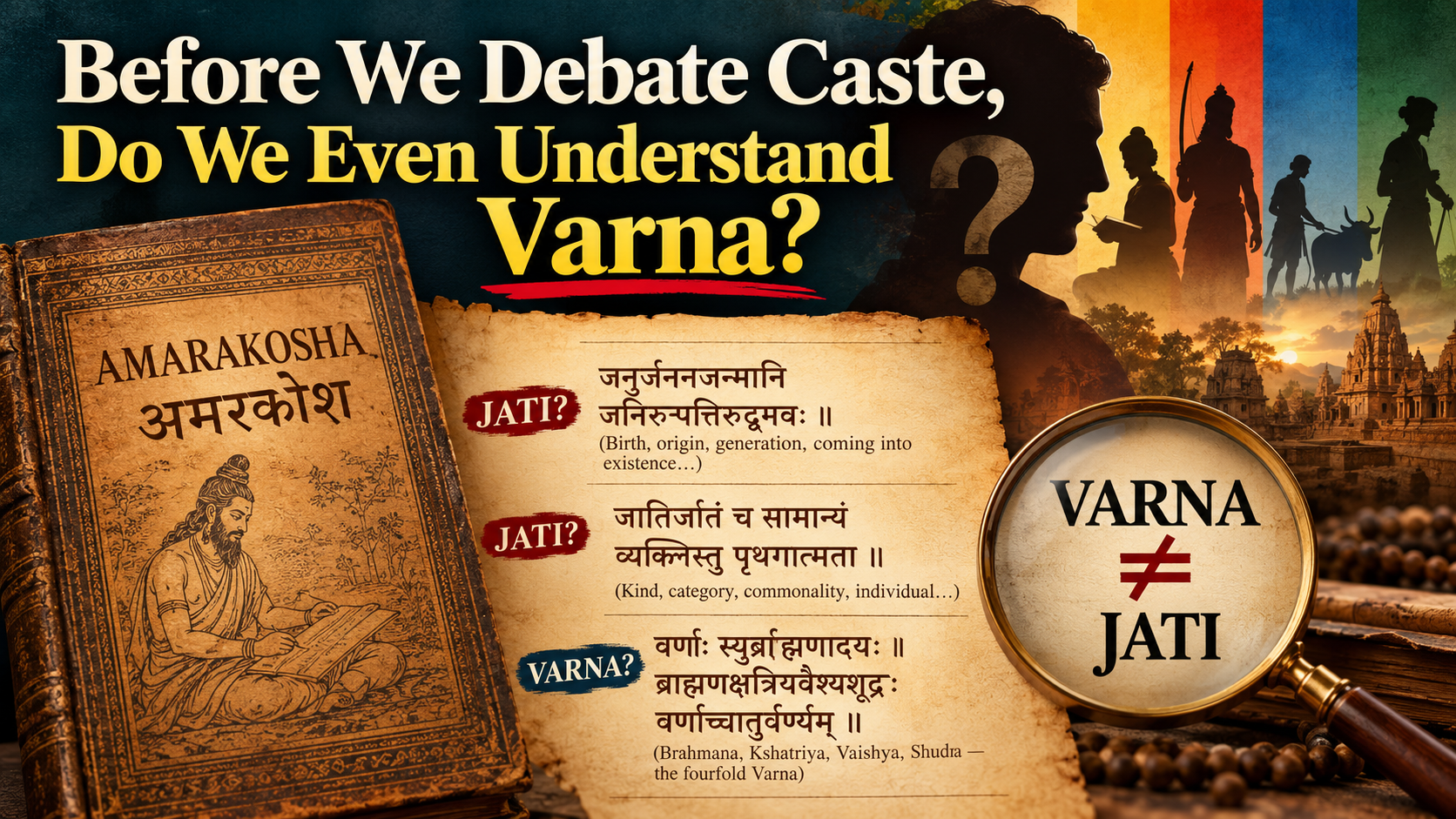
Before We Debate Caste, Do We Even Understand Varna?
When we talk about family based caste in India, we usually begin with a conclusion.
Varna means caste.
Brahmana means caste.
Kshatriya means caste.
Vaishya means caste.
Shudra means caste.
And then the entire discussion begins from there.
But there is a problem.
What if the first assumption itself is wrong?
Before we debate Varna, caste, birth, social hierarchy or discrimination, perhaps we should do something much simpler.
Let us examine the words.
What does Varna mean?
What does Jati mean?
And are Varna and Jati actually synonyms?
For this first question, I want to go back to a classical Sanskrit source.
The Amarakosha.
The Amarakosha is one of the best-known classical Sanskrit thesauri, traditionally attributed to Amarasiṃha.
And this is important because I am not beginning with a modern political definition of caste.
I am beginning with Sanskrit vocabulary.
Let us see what the text actually gives us.
First, look at this verse from the Amarakosha:
“जनुर्जननजन्मानि
जनिरुत्पत्तिरुद्भवः”
Janu,
janana,
janma,
jani,
utpatti,
and udbhava.
These are words connected with birth, generation, coming into existence, production and origin.
The next verse gives us another important group:
“जातिर्जातं च सामान्यं
व्यक्तिस्तु पृथगात्मता।”
Here we find jati, jata and samanya grouped together, while vyakti is distinguished as the individual or particular entity.
Now stop here.
This is already telling us something important.
The Sanskrit vocabulary has several words dealing with birth, origin, kind, category, commonality and individuality.
So we should be very careful before taking one modern English word — caste — and using it as though it perfectly represents every one of these Sanskrit concepts.
It does not.
And that is where our investigation begins.
Now let us come to Varna.
The Amarakosha has a specific entry for Varna in the context of the four traditional categories:
“वर्णाः स्युर्ब्राह्मणादयः”
The Varnas are Brahmana and the others.
And the next entry identifies the fourfold grouping:
“ब्राह्मणक्षत्रियवैश्यशूद्राः
वर्णाच्चातुर्वर्ण्यम्”
Brahmana,
Kshatriya,
Vaishya,
and Shudra —
these constitute the fourfold Varna.
Notice something.
The Amarakosha does not simply say:
“Varna means Jati.”
Instead, it gives us Varna as a specific term used for the fourfold classification of Brahmana, Kshatriya, Vaishya and Shudra.
This is our first important distinction.
Jati and Varna may overlap in some historical contexts.
But overlap does not automatically mean identity.
And this is exactly where many modern discussions become confusing.
We take the word caste, and then use it to translate both Varna and Jati.
Once that happens, the two concepts begin to look identical.
But the original Sanskrit terminology deserves to be examined before we make that assumption.
Let us make this very simple.
Imagine that two different Sanskrit words are translated into English using the same word.
Suppose Sanskrit has two concepts.
Concept A.
Concept B.
And English translates both of them as “caste.”
What happens?
The difference between A and B disappears.
The translation has made them look identical.
That is the problem we need to avoid.
Now, there is another important point.
Jati itself is not a one-dimensional word.
The Amarakosha verse gives:
“जातिर्जातं च सामान्यं”
Jati,
jata,
and samanya.
So jati belongs to a semantic field involving kind, category or commonality.
And the preceding verse gives the vocabulary of birth and origin:
janus,
janana,
janma,
jani,
utpatti,
udbhava.
This is why we need to be careful with a statement such as:
“Jati simply means caste.”
That is not an explanation.
It is a translation.
And sometimes a translation hides more than it reveals.
The same applies to Varna.
Varna itself has a much wider Sanskrit semantic field.
The Amarakosha uses Varna in different contexts.
It can refer to the fourfold Varna of Brahmana, Kshatriya, Vaishya and Shudra.
But Varna also appears in the semantic field of colour and in other contexts such as a letter or sound.
The Amarakosha gives extensive vocabulary for colours — white, black, yellow, red and many other shades.
So even before we enter the philosophical discussion, the word Varna already has a rich semantic history.
This raises an interesting question.
If Varna can refer to colour, and also to the fourfold classification, what exactly is the relationship between these meanings?
That question becomes important later.
But for now, let us not jump ahead.
We are still doing something much more basic.
We are defining our terms.
And this is particularly important for UPSC students.
Because in history and sociology, one of the easiest ways to make a mistake is to take a modern category and project it backward onto an ancient society.
For example, imagine that we find a word in an ancient text.
We translate it using a modern term.
Then we assume that the ancient concept had exactly the same meaning as the modern term.
That is called anachronism.
And ancient Indian social history is full of opportunities for this mistake.
So when we encounter the word Varna, we should ask:
What does this word mean in this particular text?
When we encounter Jati, we should ask:
What does Jati mean in this particular context?
And when we encounter the English word caste, we should ask:
Which Sanskrit word is actually being translated as caste?
Varna?
Jati?
Kula?
Gotra?
Or something else?
These are not necessarily interchangeable concepts.
And this distinction becomes even more important when we move from vocabulary to philosophy.
Because later we will come to one of the most famous statements in the Bhagavad Gita.
Krishna says:
“चातुर्वर्ण्यं मया सृष्टं
गुणकर्मविभागशः”
Chaturvarnyam maya srishtam
guna-karma-vibhagashah.
The fourfold Varna is described through guna and karma.
That verse will be the subject of another episode.
But notice the sequence.
We have not started by saying:
“Varna was definitely this.”
We have started by asking:
“What does the word mean?”
That is the correct order of investigation.
First vocabulary.
Then text.
Then context.
Then historical evidence.
Then interpretation.
Not the other way around.
And this also prevents another common mistake.
Suppose someone says:
“Varna was always hereditary.”
That is a historical claim.
It requires evidence.
Similarly, if someone says:
“Varna was never connected with birth.”
That is also a historical claim.
It requires evidence.
Neither statement can be established simply by repeating the modern meaning of the word caste.
We have to examine the texts.
And different texts may give us different kinds of evidence.
The Bhagavad Gita may emphasize guna and karma.
The Mahabharata may contain discussions about conduct, status and movement between categories.
Dharmashastra texts may discuss birth, lineage, marriage and social duties.
Later historical societies may organize themselves through thousands of Jatis.
Colonial administrators may classify those communities using the category “caste.”
And modern India may use caste categories for constitutional, administrative and political purposes.
All of these belong to different historical layers.
If we mix them together, we get one giant category called “caste.”
And then we imagine that the same institution has existed unchanged for thousands of years.
That is precisely the historical question we need to investigate.
So, at the end of this first episode, I want you to remember only three things.
Number one.
Varna and Jati should not automatically be treated as synonyms.
Number two.
The Amarakosha gives us a much richer Sanskrit vocabulary around birth, origin, kind, category and Varna than the single English word “caste” suggests.
And number three.
Before deciding what Varna historically meant, we have to examine the actual texts in which the word occurs.
This is not about defending or attacking an ancient system.
It is about understanding it.
And that distinction matters.
Because if we begin with a modern conclusion, we will find evidence only for that conclusion.
But if we begin with the words themselves, we have a chance to discover something more interesting.
So here is the question for the next episode:
If Varna and Jati are not automatically the same thing…
then what exactly does Varna mean?
And why does the word also mean “colour”?
That is where the investigation really begins.
Because perhaps the first mistake in the entire debate is not in the answer.
Perhaps it is in the question.



Leave a Reply