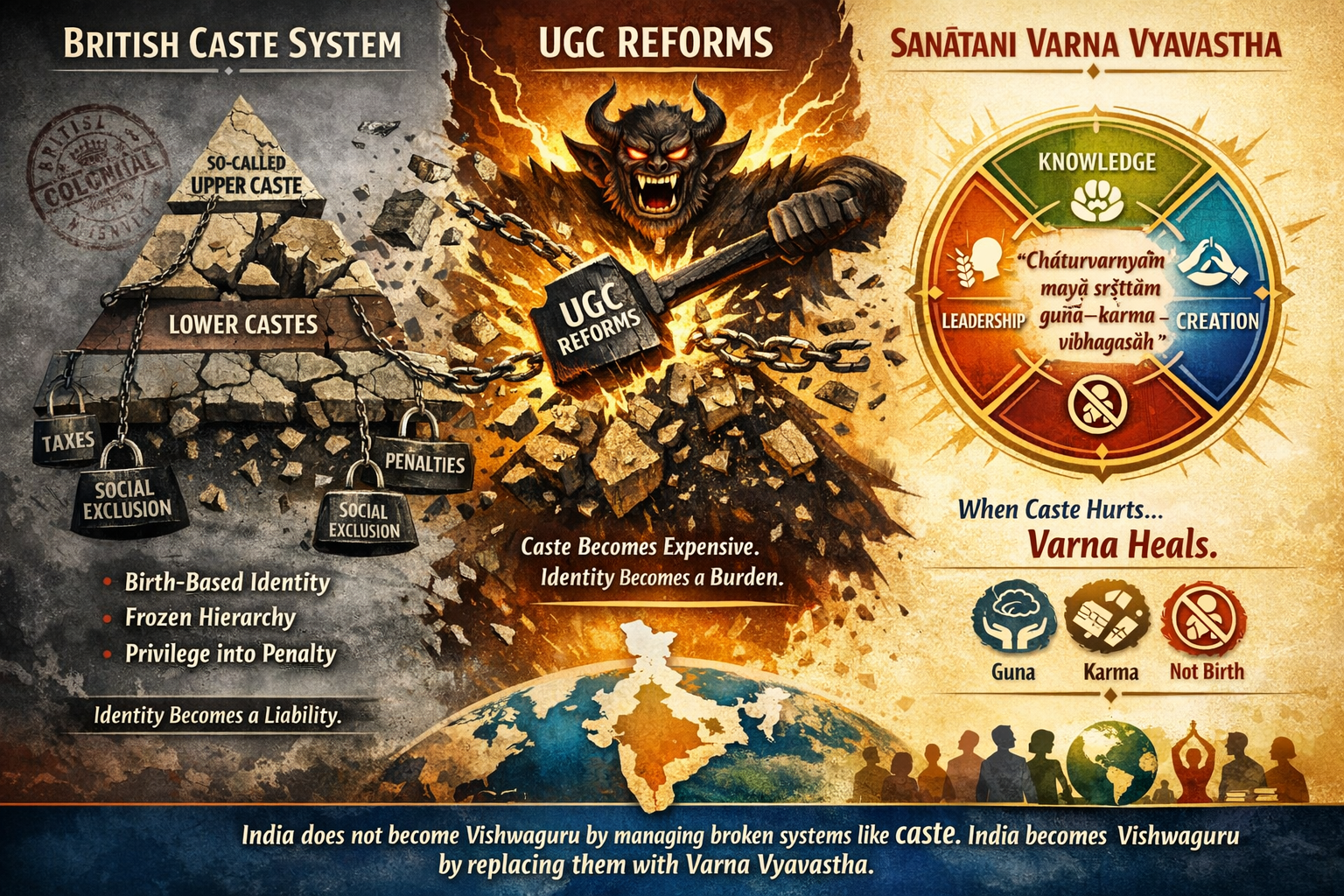
The recent reforms by the University Grants Commission (UGC) were introduced under the leadership of Narendra Modi. They represent more than educational restructuring. They signify a profound change beyond education. They mark a civilizational intervention. This intervention works not by persuasion or moral lectures. Instead, it alters incentives, pressures, and long-standing psychological dependencies.
Their real impact is not merely institutional.
It is psychological, social, and civilizational.
For the first time in modern India, a state mechanism has made continued dependence on caste identity structurally uncomfortable. This is especially true for the so-called “upper caste” identity. It is also risky and ultimately unsustainable. This is not accidental. It is the unavoidable consequence of dismantling a British-frozen caste architecture that had survived long after colonial rule ended.
The result is a hard but necessary transition toward Varna Vyavastha.
And yes, the change had to begin with those who benefited most from the distortion—those historically described as savarna. This is an uncomfortable truth, but an essential one.
The British Caste System Was Never Sanātani
To grasp how significant this transition is, one needs to address a commonly overlooked fact –
The caste system as we know it today is not a Sanātani creation.
Sanātan Dharma never organized society around birth-based hierarchy. What it articulated instead was Varna Vyavastha, a fluid, functional, and ethical framework rooted in human nature and action.
This is stated unambiguously in the Bhagavad Gītā:
“Chāturvarṇyaṁ mayā sṛṣṭaṁ guṇa–karma–vibhāgaśaḥ”
— Bhagavad Gita
The meaning is both precise and revolutionary. Even today, society is organized by guna (qualities, tendencies) and karma (action, conduct)—not by birth.
Varna was never a hereditary rank.
It was a dynamic classification of responsibility.
The British were unable to comprehend this fluidity. They froze Indian society into rigid census categories. This converted a living social system into a static identity hierarchy. Over time, this distortion became normalized, defended, and mistaken for tradition.
The tragedy is not merely that caste oppressed some.
It is that caste corrupted everyone.
How Caste Became the Engine of Religious Conversion
One of the most devastating consequences of this frozen caste structure has been its role as a conversion engine.
Across centuries, caste humiliation, exclusion, and resentment became the primary fault line exploited by missionary forces. Conversion was rarely about theology; it was about escape from indignity.
When dignity is denied structurally, belief becomes negotiable.
This is the uncomfortable reality India must face:
- People did not abandon Sanātan Dharma because its philosophy failed.
- They abandoned it because its social distortion failed them.
The British caste system created permanent psychological wounds:
- You are born inferior.
- You will remain inferior.
- Your effort cannot change your place.
Under such conditions, conversion becomes not betrayal, but survival.
Why Varna Vyavastha Ends Conversion Without Coercion
The UGC reforms quietly strike at this root.
They dismantle the very structure that produced humiliation, resentment, and grievance. They achieve this by turning birth-based advantage into a liability instead of an asset. When varna-based merit becomes the organizing principle, the emotional fuel for conversion disappears.
Varna Vyavastha heals in a way no law or sermon ever can.
- It restores dignity without confrontation.
- It creates belonging without coercion.
- It makes ghar vapasi organic rather than ideological.
And this inclusivity is not limited to Hindus who converted under pressure.
It extends to humanity itself.
Varna Vyavastha does not demand belief in a god.
It demands alignment between nature, work, and ethics.
That is why it is civilizational, not sectarian.
Why “Pure Skill” Is Not Enough
A crucial misunderstanding in modern discourse is the idea that merit = skill.
This is a dangerous reduction.
A surgeon can have extraordinary technical skill and still harvest organs illegally.
A scientist can be brilliant and still weaponize knowledge destructively.
A bureaucrat can be efficient and still be corrupt.
Western meritocracy optimizes capability without conscience.
Sanātani Varna Vyavastha never made this mistake.
It insists that merit must be spiritual, not merely technical.
Varna evaluates:
- Skill and
- Intention and
- Conduct and
- Responsibility
A Brahmin without ethics is not a Brahmin.
A Kshatriya without restraint is not a Kshatriya.
A Vaishya without fairness is not a Vaishya.
A Shudra without sincerity is not a Shudra.
This is why Varna Vyavastha is not just efficient—it is safe.
It prevents the rise of highly skilled predators masquerading as professionals.
Why the Pressure Had to Fall on the “Upper Castes”
For decades, sections labeled as “upper castes” survived on the psychological comfort of inherited assurance. Even when material privilege declined, the identity privilege remained intact.
The UGC reforms dismantle this comfort ruthlessly.
Caste identity now:
- Attracts penalties.
- Carries social risk.
- Yields no institutional benefit.
- Increases compliance burden without return.
Ancestry no longer pays dividends.
In fact, it costs.
This pressure is not ideological.
It is structural.
As institutions begin penalizing caste identity itself, individuals are forced to rediscover themselves through guna and karma.
This is not persecution.
It is de-addiction.
The so-called “upper castes” are not being attacked.
They are being liberated from a British-imposed mental prison.
The choice becomes unavoidable:
- Cling to a collapsing caste identity, or
- Return to Sanātani roots where dignity flows from dharma, not descent.
Why Sanātan Dharma Cannot Return Without Varna Vyavastha
Rituals alone cannot sustain a civilization.
Symbols without structure become hollow.
Faith without social alignment becomes fragile.
Sanātan Dharma is not merely a religion—it is a complete civilizational operating system. And Varna Vyavastha is its social backbone.
Without Varna:
- Dharma collapses into identity politics.
- Spirituality becomes performative.
- Society fractures into grievance groups.
With Varna:
- Diversity becomes functional.
- Difference becomes complementary.
- Purpose replaces resentment.
The UGC reforms, perhaps unintentionally, have operationalized this philosophy for modern India.
From India to Humanity: Varna as a Scientific Social System
This is where the conversation must expand beyond India.
Varna Vyavastha is not “Hindu” in the narrow sense.
It is human.
Every society struggles with:
- Misalignment between aptitude and occupation.
- Talent waste.
- Identity-based resentment.
- Moral collapse in high-skill professions.
Varna Vyavastha addresses these universally by asking a simple question:
What is your nature, and how can it best serve the whole?
That is why it will spread—not as religion, but as social dharma.
Just as Yoga and Ayurveda crossed borders without conversion, Varna Vyavastha will cross cultures without imposing belief.
Political Courage and Civilizational Vision
That these reforms unsettle sections traditionally seen as political supporters makes them even more significant.
It takes extraordinary courage to:
- Discomfort inherited privilege.
- Absorb backlash.
- Think in decades, not election cycles.
This is not vote-bank management.
This is civilizational leadership.
Only the BJP, with its ideological clarity and political capital, could attempt such a reset.
The Proven Pattern of Revival
India has seen this before.
Ayurveda was dismissed as superstition.
Yoga was mocked as primitive.
Both were revived when institutions aligned with civilizational intelligence rather than colonial validation.
Today, they are global benchmarks.
Varna Vyavastha follows the same trajectory.
The Final Truth
The West built meritocracy without the soul.
India offers meritocracy with conscience.
Varna Vyavastha was never hierarchy.
It was harmony.
Different roles.
Equal dignity.
Shared purpose.
The UGC reforms are not merely policy.
They are civilizational architecture.
India will not become Vishwaguru by managing broken systems like caste.
India becomes Vishwaguru by replacing them with Varna Vyavastha.
And when that happens, it will not just reclaim its past—it will offer the world a future.
Calculate your varna now.
Leave a Reply